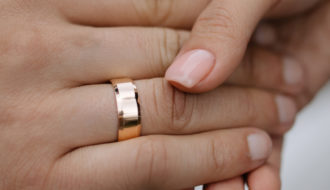
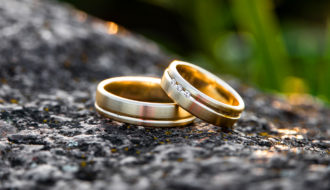
Gold has been the metal of marriage for 5,000 years. There is a reason: no other material carries the same weight of meaning, the same warmth of colour, or the same promise of permanence.
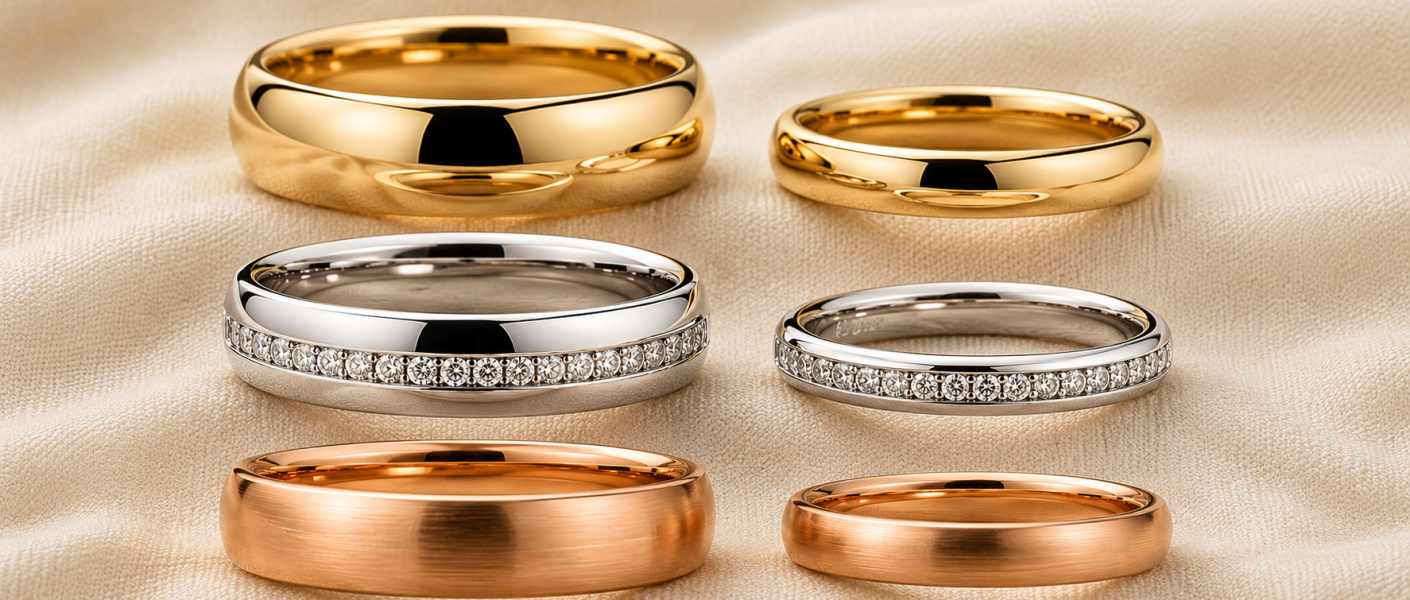
But in 2026, gold wedding bands are not what they were. The choice between yellow, white, and rose gold is now a genuine style decision. Karat levels affect both durability and colour. Width ratios between his and hers bands matter more than most couples realise. And the finish — polished, satin, hammered, or brushed — determines how the ring wears and looks a decade from now.
This guide covers 18 his and hers gold wedding band sets across all three gold tones and both major karat levels, with a complete buyer’s guide to karat, width, and finish so you make one decision and make it right.
14K Gold
The most chosen karat for his and hers wedding bands — optimal balance of purity, durability,
and colour depth
and colour depth
Already know your gold tone? Jump to: Yellow Gold Sets ↓| White Gold Sets ↓ | Rose Gold Sets ↓|Or read the full gold comparison guide first.
Gold Wedding Bands: The 4 Decisions Every Couple Needs to Make
1. Yellow, White, or Rose Gold?
Yellow gold is classic and warm. White gold is modern and bright (rhodium-plated for a silver-white colour). Rose gold is romantic and trending — the most-searched gold tone in 2026. The right answer depends on your skin tone, your engagement ring metal, and your personal aesthetic. All three are equally durable at the same karat level.
2. 14K or 18K?
14K gold (58.3% pure) is harder and more scratch-resistant than 18K. It’s the most popular choice for wedding bands worn daily. 18K gold (75% pure) is richer in colour — deeper yellow, deeper rose — and carries more prestige, but scratches more easily. For couples with very active lifestyles, 14K is the practical recommendation. For those who want maximum
gold richness and wear their rings carefully, 18K is worth the upgrade.
gold richness and wear their rings carefully, 18K is worth the upgrade.
3. What width?
His band width typically runs 6–9mm. Her band runs 2.5–5mm. The most harmonious pairing is his band at roughly twice the width of hers. A 7mm his band with a 3.5mm her band is the most universally flattering proportion. See the width guide table below for all options.
4. Polish, Satin, or Hammered?
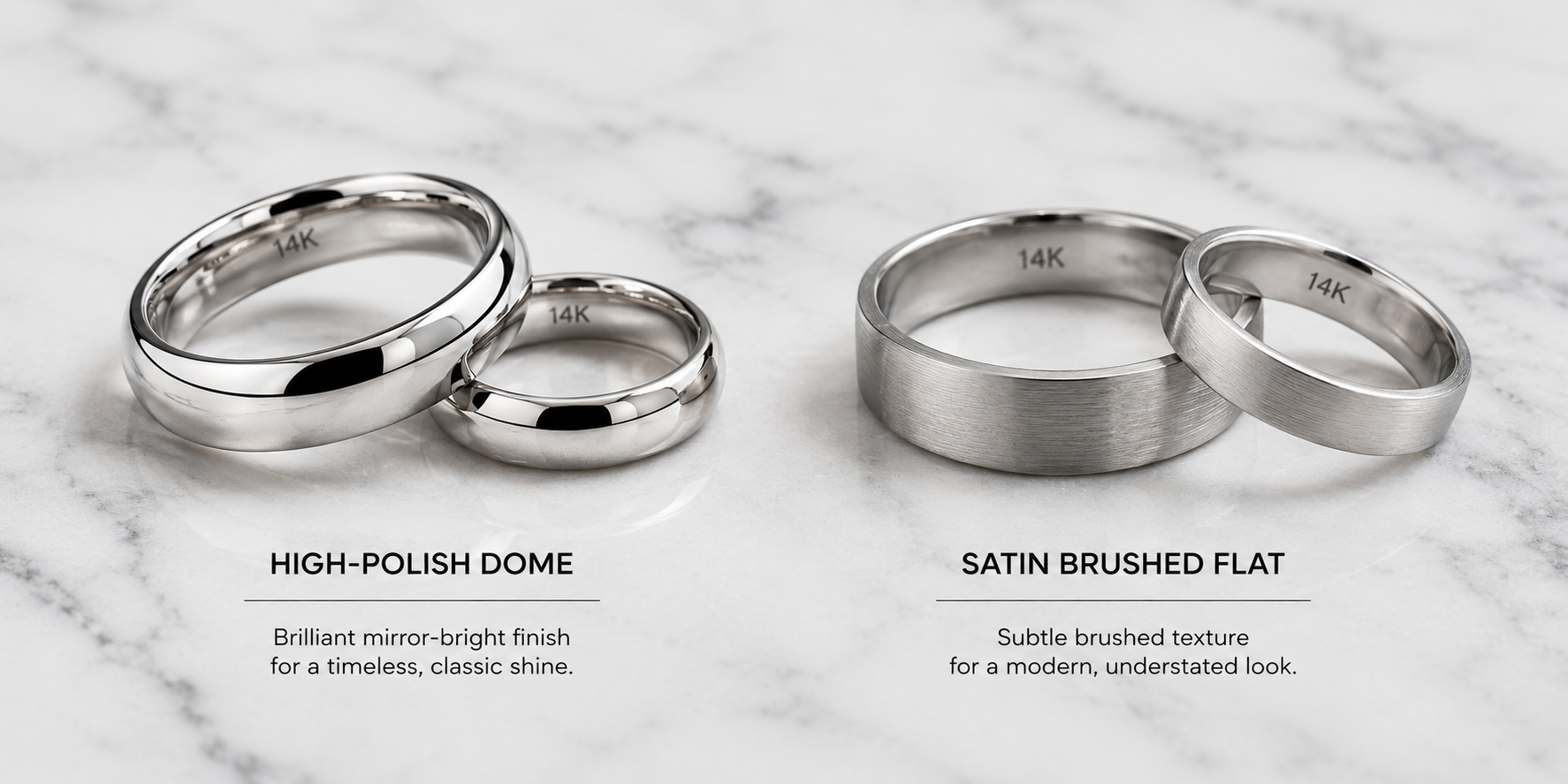
High-polish gold is classic and shows the metal’s full colour brilliance — but shows scratches more readily. Satin (brushed) finish is matte and warm — micro-scratches blend into the texture and become invisible. Hammered finish is artisanal and organic — each ring is visually unique. For daily-wear bands, satin or hammered tend to age more gracefully than high-polish.
Yellow Gold His and Hers Wedding Bands — Sets 1–6
Yellow gold is the oldest and most traditional wedding band metal. In 2026 it is also having a strong renaissance — search interest for yellow gold wedding bands is up 31% year-on-year as couples move away from the all-white-metal trend of the 2010s.
#1 Classic Polished Dome — 14K Yellow Gold
$1,180–$1,560 for both
Gold: 14K Yellow Gold | Finish: High-polish dome
His band: 7mm 14K yellow gold classic dome. Timeless round profile, comfort-fit interior. The most iconic men’s gold wedding band profile, unchanged for 80 years.
Her band: 3mm 14K yellow gold classic dome. Petite, elegant, and universally flattering. Pairs with virtually any engagement ring style.
Why couples choose this: The polished dome is the definitive gold wedding band silhouette. It has been the most popular men’s ring profile since the mid-20th century for good reason: it looks correct on every hand, in every context, for every decade of marriage.
Perfect for: Couples who want the most classic, timeless gold band that will never look dated.
#2 Satin-Finish Flat Band — 14K Yellow Gold
$1,220–$1,640 for both
Gold: 14K Yellow Gold | Finish: Brushed satin matte
His band: 8mm 14K yellow gold flat band, full satin brushed finish. The flat profile reads as modern and architectural against the warm gold colour.
Her band: 3.5mm 14K yellow gold flat satin band. Slim, contemporary, and notably low-maintenance — daily micro-scratches vanish into the brushed texture.
Why couples choose this: The satin finish is the smartest practical choice for active wearers. Unlike high-polish, which shows every minor contact scratch, a brushed finish absorbs surface wear into its texture. The ring looks the same after 10 years of daily wear as it did on the wedding day.
Perfect for: Professionals, athletes, or anyone who uses their hands at work. Also for couples who prefer a modern, understated aesthetic.
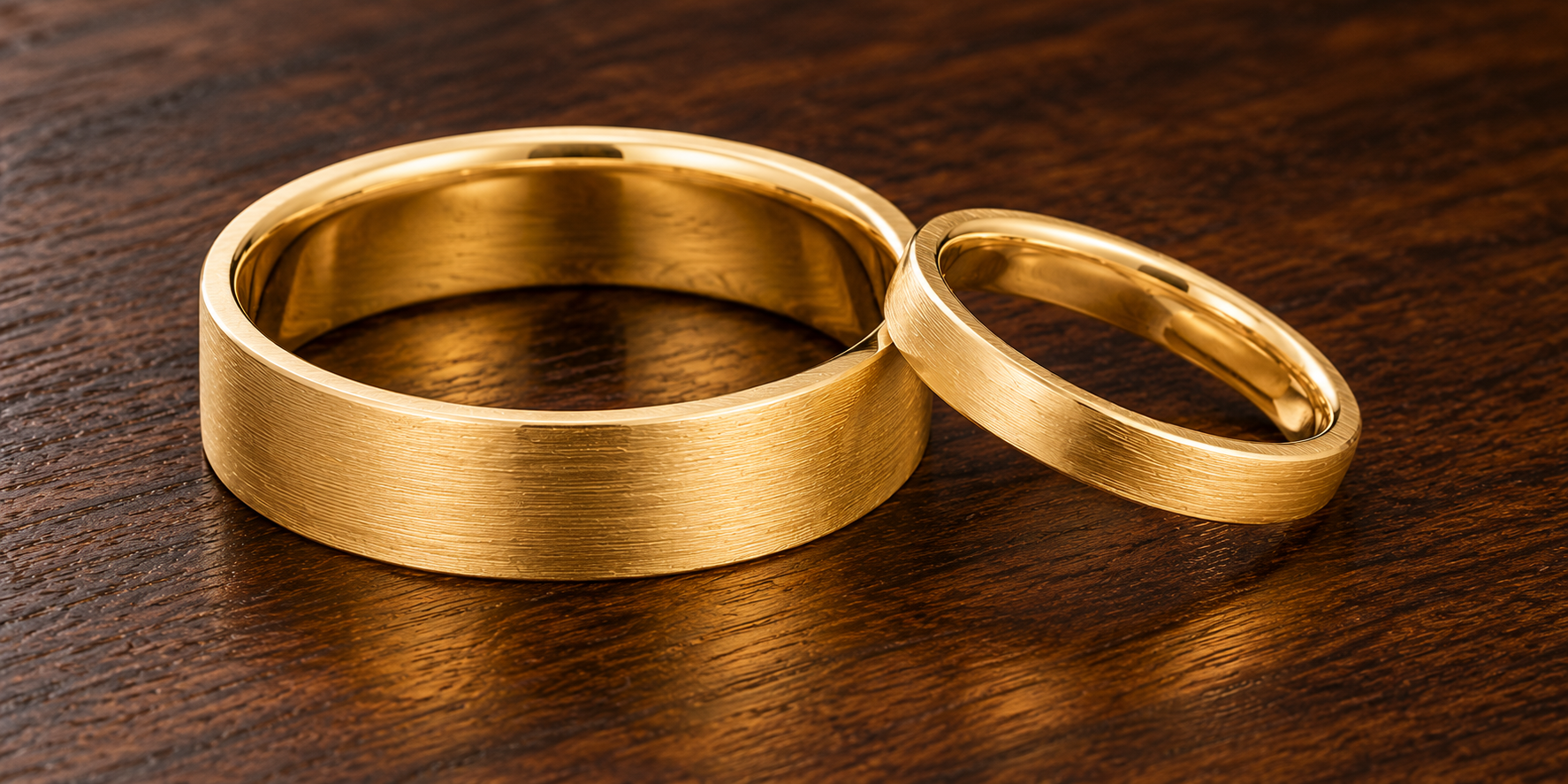
#3 Hammered Yellow Gold Set — Artisan Finish
$1,380–$1,860 for both
Gold: 14K Yellow Gold | Finish: Hand-hammered texture
His band: 8mm 14K yellow gold hammered band. The hammered surface creates an organic, forged appearance — each facet catches light differently.
Her band: 4mm 14K yellow gold hammered band. Matching texture on a slimmer profile. The organic surface gives the ring a hand-crafted, individual character.
Why couples choose this: A hammered finish mimics the appearance of hand-forged gold — the technique traditionally used by goldsmiths before mechanised production. No two hammered rings are perfectly identical. The faceted surface creates multi-directional light reflection that gives yellow gold a dynamic, living quality rather than a static shine.
Perfect for: Couples who want an artisan aesthetic or who appreciate the idea of a ring that looks hand-made.
→ View This Set at LoveWeddingBands
→ View This Set at LoveWeddingBands
#4 Two-Tone Yellow & White Gold Set
$1,560–$2,100 for both
Gold: 14K Yellow Gold shank + 14K White Gold centre | Finish: Polished two-tone
His band: 8mm two-tone: yellow gold outer edges, white gold centre channel. The contrast creates a graphic stripe of colour across the band.
Her band: 4mm two-tone: yellow gold band with white gold pavé-set centre stripe. The combination of both metals makes this the most versatile design — it pairs with both yellow and white gold engagement rings.
Why couples choose this: Two-tone design solves the most common engagement ring pairing problem: when one partner has a yellow gold engagement ring and the other prefers white gold, or when her engagement ring is white gold but yellow gold wedding bands are the family tradition. Both metals are present in both rings.
Perfect for: Couples with mixed metal preferences, or those who want visual interest beyond a single-metal band.
#5 Diamond-Accent Yellow Gold Set
$1,720–$2,400 for both
Gold: 14K Yellow Gold | Finish: High-polish with channel-set diamonds
His band: 8mm 14K yellow gold with a recessed channel of round brilliant diamonds along the centre. 0.15 ctw G–H colour, SI1. The yellow gold warming the diamonds’ appearance.
Her band: 3.5mm 14K yellow gold pavé half-eternity. 0.45 ctw round brilliant, H–I colour, VS2. Diamond colour grades H–I look whiter in yellow gold settings than in white gold.
Why couples choose this: Yellow gold is uniquely forgiving of lower diamond colour grades. Diamonds graded H–I appear slightly yellow-tinted in white gold, but in yellow gold the warm metal tone neutralises any yellow tint and the stones appear white. This means couples can access better cut quality at the same budget by choosing yellow gold.
Perfect for: Couples who want diamonds in their bands and want to maximise sparkle per dollar.
#6 18K Yellow Gold Luxury Plain Set
$2,100–$2,900 for both
Gold: 18K Yellow Gold | Finish: High-polish dome
His band: 7mm 18K yellow gold classic dome. The higher gold purity produces a noticeably richer, deeper yellow than 14K — immediately identifiable as high-karat gold.
Her band: 3mm 18K yellow gold petite dome. The same rich colour in a delicate feminine profile.
Why couples choose this: 18K yellow gold has a colour that 14K simply cannot match. The richness comes directly from the higher gold content (75% vs 58.3%). For those who grew up seeing high-karat European gold jewelry — or for whom the depth of gold colour matters — 18K is the only choice. It is softer than 14K, but a plain band worn carefully ages beautifully.
Perfect for: Those who recognise and value high-karat gold colour. Also for anniversary upgrades from 14K starter bands.
White Gold His and Hers Wedding Bands — Sets 7–12
White gold is the most popular choice for his and hers wedding bands when one or both partners have a white gold or platinum engagement ring. Its bright silver-white surface is achieved through rhodium plating — a layer of rhodium over the gold alloy that creates a brilliant, mirror-white finish.
Important note on white gold:
White gold requires rhodium re-plating every 1–2 years as the plating wears through to the slightly yellow gold alloy beneath. This is a standard jeweler service costing $40–$80. If you want a naturally white metal that never needs re-plating, consider platinum (see our diamond wedding bands guide for platinum options).
#7 Classic Polished Dome — 14K White Gold
$1,240–$1,640 for both
Gold: 14K White Gold | Finish: High-polish rhodium dome
His band: 7mm 14K white gold classic dome. The rhodium surface creates a bright, mirror finish indistinguishable from platinum at this width.
Her band: 3mm 14K white gold petite dome. The most popular women’s white gold wedding band profile — simple, elegant, and compatible with any engagement ring.
Why couples choose this: 14K white gold is the workhorse of the bridal category for good reason. The gold alloy provides strength and durability; the rhodium plating provides the brilliant white surface. It is the closest match to a platinum engagement ring shank at a significantly lower price.
Perfect for: Anyone pairing with a white gold or platinum engagement ring. The most versatile his and hers white gold set.
#8 Satin White Gold Flat Set — Modern Minimalist
$1,280–$1,700 for both
Gold: 14K White Gold | Finish: Brushed satin
His band: 8mm 14K white gold flat satin band. The brushed finish gives the white gold a softer, more matte appearance — contemporary and architectural.
Her band: 3.5mm 14K white gold flat satin band. The matte finish makes this band surprisingly practical — it does not show fingerprints or daily micro-scratches.
Why couples choose this: The satin finish on white gold creates a cooler, more architectural look than the high-polish version. Many design-minded couples prefer it for this reason. Practically, the brushed finish hides the gradual wearing of the rhodium plating better than a polished surface, which means it looks consistent for longer between re-plating visits.
Perfect for: Minimalists and design-focused couples. Also ideal for professionals who want a non-reflective, low-key band.
#9 Milgrain Border White Gold Set — Vintage
$1,480–$1,980 for both
Gold: 14K White Gold | Finish: High-polish with milgrain edges
His band: 8mm 14K white gold with hand-applied milgrain borders on both edges. The beaded detailing frames the band with an antique craftsman’s signature.
Her band: 3.5mm 14K white gold with milgrain borders. The intricate beading scale perfectly on a narrow band, giving it a delicate lacy character.
Why couples choose this: Milgrain — derived from the French “mille grains” (thousand grains) — is a hand-finishing technique in which a jeweler rolls a toothed wheel along the band edge to create a continuous row of tiny metal beads. It is a hallmark of Edwardian and Art Deco jewelry, which is why it pairs so naturally with vintage and antique-style engagement rings.
Perfect for: Couples with vintage-inspired or Art Deco engagement rings. Also beautiful as a standalone design.
#10 Comfort-Fit Wide White Gold Set
$1,380–$1,840 for both
Gold: 14K White Gold | Finish: High-polish, comfort-fit interior
His band: 9mm 14K white gold wide flat band with rounded comfort-fit interior. The width gives maximum presence on his hand.
Her band: 4mm 14K white gold comfort-fit dome. Slightly wider than standard, the extra millimetre gives the band more visual weight without being oversized.
Why couples choose this: Comfort-fit refers to a domed interior — the inside of the band curves away from the finger rather than sitting as a flat ring. This reduces friction at the edges during removal and allows air to circulate beneath the band. On a wide band (9mm), comfort-fit is near-essential for practical daily wear.
Perfect for: Anyone choosing a wider band width — particularly for his 8mm+ rings. Also for couples who remove rings frequently.
#11 Diamond Pavé White Gold Set
$1,780–$2,500 for both
Gold: 14K White Gold | Finish: High-polish with pavé diamonds
His band: 8mm 14K white gold with a single pavé diamond row along the centre. 0.18 ctw round brilliant G–H, VS2. The white gold amplifies the diamonds’ colourless brilliance.
Her band: 3.5mm 14K white gold pavé half-eternity. 0.55 ctw G–H, VS1–VS2. The white metal and colourless diamonds create a single unified surface of light.
Why couples choose this: White gold is the optimal metal for showcasing colourless diamonds (D–H colour grades). The bright rhodium surface reflects the same cool white light as the diamonds, creating a seamless visual harmony. Yellow gold introduces a warm reflection that can contrast with near-colourless stones.
Perfect for: Couples who want diamonds and want maximum diamond brilliance. The premium white gold + near-colourless diamond combination.
#12 18K White Gold Eternity Set
$2,800–$3,800 for both
Gold: 18K White Gold | Finish: High-polish full-eternity diamond channel
His band: 7mm 18K white gold channel-set full eternity. 0.35 ctw round brilliant F–G, VS1. The higher gold purity means a slightly softer, more luxurious feel.
Her band: 3mm 18K white gold full-eternity channel band. 0.90 ctw round brilliant F–G, VS1. An unbroken circle of diamonds in the purest white gold available without moving to platinum.
Why couples choose this: 18K white gold has a slightly softer, finer feel than 14K — perceptibly different to those who handle jewelry regularly. Paired with F–G, VS1 diamonds, this set sits one step below platinum in quality and two steps above standard 14K. For couples who want the best short of platinum.
Perfect for: Couples who want a near-platinum-level finish. Also for upgrades and significant anniversary gifts.
Rose Gold His and Hers Wedding Bands — Sets 13–18
Rose gold is the most searched wedding band metal of 2026. Its warm peachy-pink tone flatters virtually all skin tones, photographs beautifully, and pairs with both yellow and white gold engagement rings.
#13 Classic Dome Rose Gold Set — 14K
$1,240–$1,640 for both
Gold: 14K Rose Gold | Finish: High-polish dome
His band: 7mm 14K rose gold classic dome. The warm peachy-rose tone on a dome profile is the signature rose gold wedding band silhouette.
Her band: 3mm 14K rose gold petite dome. A delicate band with a colour that flatters olive, medium, and dark skin tones particularly well.
Why couples choose this: Rose gold gets its characteristic colour from copper in the alloy. 14K rose gold contains approximately 41.7% copper, which gives it a warm, slightly pinkish-orange tone.
The colour is completely stable — it does not require rhodium plating like white gold and the tone deepens slightly over time as the copper surface develops a natural patina.
The colour is completely stable — it does not require rhodium plating like white gold and the tone deepens slightly over time as the copper surface develops a natural patina.
Perfect for: Couples attracted to the warm, romantic rose gold aesthetic. Flattering on most skin tones.
#14 Satin Rose Gold Flat Set — Modern
$1,280–$1,700 for both
Gold: 14K Rose Gold | Finish: Brushed satin matte
His band: 8mm 14K rose gold flat band, satin brushed finish. The matte surface gives the warm colour a softer, more subdued appearance.
Her band: 3.5mm 14K rose gold flat satin band. The combination of rose gold’s warmth and the matte finish creates a particularly rich, velvety appearance.
Why couples choose this: Rose gold with a satin finish is one of the most photographed ring combinations in bridal media. The warm copper tone combined with the directional brushed texture creates depth and richness that polished rose gold doesn’t have. It also hides micro-scratches as well as any brushed metal.
Perfect for: Couples who want rose gold’s warmth with a contemporary, non-traditional finish.
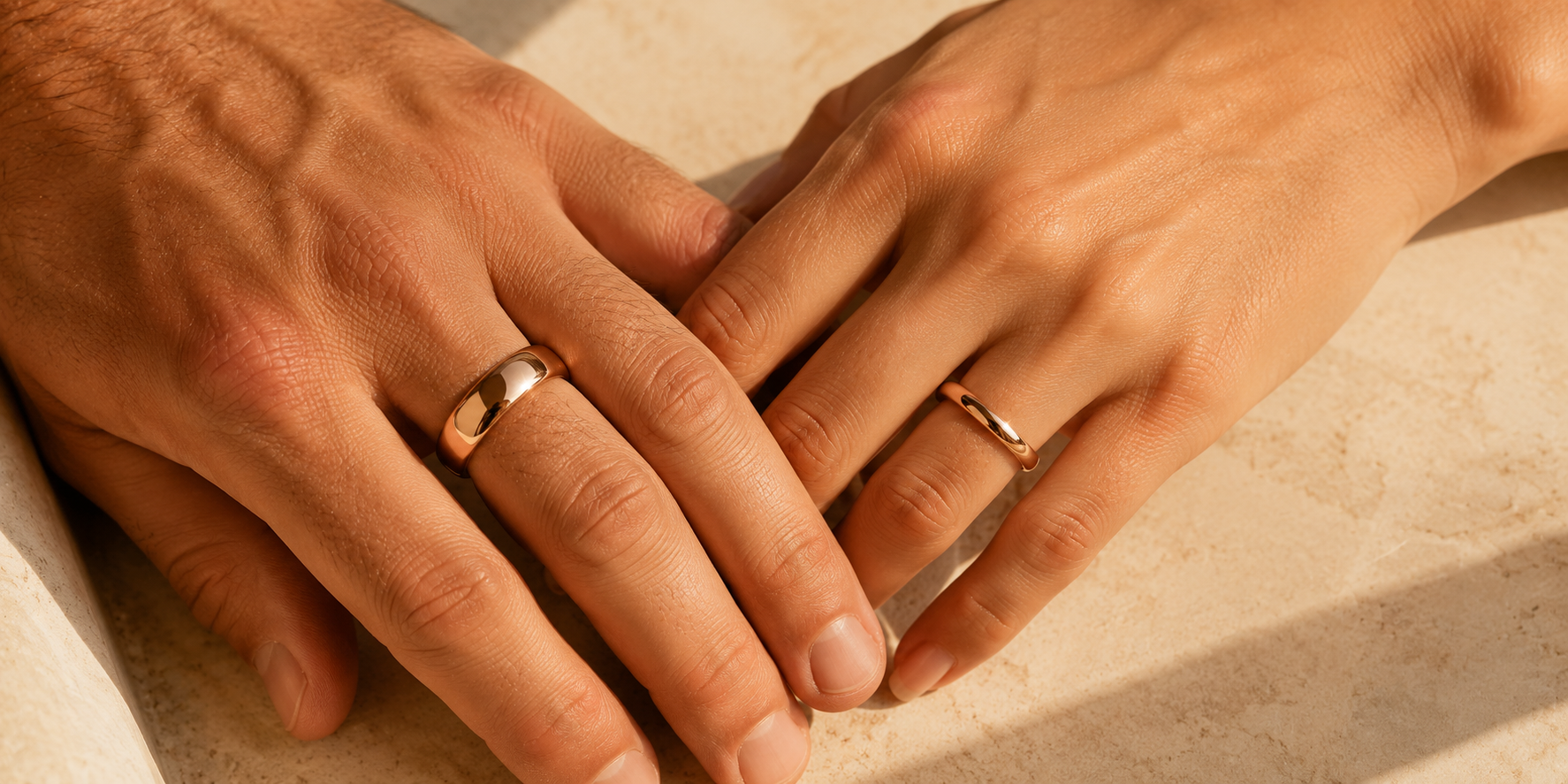
#15 Hammered Rose Gold Set — Organic
$1,420–$1,900 for both
Gold: 14K Rose Gold | Finish: Hand-hammered texture
His band: 8mm 14K rose gold hammered band. The hammered facets give the warm copper-pink tone a dynamic, shifting quality as the hand moves.
Her band:4mm 14K rose gold hammered band. Matching texture. The combination of rose gold’s warmth and the organic hammered surface reads as uniquely artisanal.
Why couples choose this: Hammered rose gold is one of the most distinctive combinations in our collection. The warm copper tones of the rose gold interact with the angular hammered facets
to create a constantly shifting colour and light effect. No two rings are identical — the hammering process gives each ring its own surface character.
to create a constantly shifting colour and light effect. No two rings are identical — the hammering process gives each ring its own surface character.
Perfect for: Couples with a love of craft, nature, or organic design. Also pairs beautifully with rough-cut or organic-style engagement rings.
→ View This Set at LoveWeddingBands
→ View This Set at LoveWeddingBands
#16 Rose Gold Pavé Diamond Set
$1,680–$2,300 for both
Gold:14K Rose Gold | Finish: High-polish with pavé diamonds
His band: 8mm 14K rose gold with a single row of pavé diamonds along the centre groove. 0.15 ctw round brilliant I–J colour, SI1. The rose gold’s warm tone makes I–J colour diamonds appear completely white.
Her band: 3.5mm 14K rose gold pavé half-eternity. 0.50 ctw round brilliant I–J, VS2–SI1. The peachy-pink metal and diamond sparkle combination is consistently one of our most-viewed sets.
Why couples choose this: Rose gold is particularly efficient for diamond bands. Because the warm metal tone masks any yellowing in lower-colour diamonds (I–J range), couples can buy better cut quality at the same price point. The resulting sparkle — warm-toned but brilliant — is one of the most photographed ring combinations in bridal media.
Perfect for: Romantic couples who want diamonds. Rose gold maximises diamond value and warmth simultaneously.
#17 Rose & White Gold Two-Tone Set
$1,580–$2,100 for both
Gold: 14K Rose Gold + 14K White Gold | Finish: Polished two-tone
His band: 8mm band: rose gold outer edges, white gold centre channel. A graphic two-tone design that reads as architectural and considered.
Her band: 4mm band: white gold band with rose gold pavé-set centre stripe. The reversal of the colour arrangement between his and hers adds visual interest to the matched pair.
Why couples choose this: Reversing the colour arrangement between his and hers — his has rose-outer/white-centre, hers has white-outer/rose-centre — is a sophisticated design choice. The bands visually complement each other as a pair precisely because they are mirror-inverted rather than identical. It reads as a deliberate design rather than a coincidence.
Perfect for: Design-aware couples who want their set to be clearly recognisable as a pair with a story.
#18 18K Rose Gold Statement Set
$2,200–$3,100 for both
Gold: 18K Rose Gold | Finish: High-polish dome
His band: 7mm 18K rose gold dome. The higher gold content deepens the rose tone to a richer, more saturated pink—noticeably more intense than 14K.
Her band: 3mm 18K rose gold petite dome. The same rich colour in a delicate profile. 18K rose gold has a distinctively deeper, almost coral tone.
Why couples choose this: 18K rose gold has a deeper, more saturated pink tone than 14K — the result of the higher overall gold content (75%) combined with the copper component. If 14K rose gold is peachy-pink, 18K rose gold is closer to a warm coral. For those who fell in love with rose gold specifically for its colour depth, 18K is the version that delivers maximum impact.
Perfect for: Couples who want the most vivid rose gold colour. Also for second rings, anniversary upgrades, or those buying in gold-rich European or Middle Eastern markets.
All Gold Types Compared — Complete Reference Table
Use this table to make your final karat and colour decision before purchasing.
| Gold Type | Purity | Colour | Durability | Resizable? | Best His & Hers Pairing | Typical Set Price |
|---|---|---|---|---|---|---|
| 10K Yellow Gold | 41.7% gold | Light yellow | ★★★★★ Most durable | Yes | Classic plain bands, wide profiles | $1,100–$1,800 |
| 14K Yellow Gold | 58.3% gold | Warm medium yellow | ★★★★☆ | Yes | Classic, diamond bands, engraved | $1,300–$2,600 |
| 18K Yellow Gold | 75% gold | Rich deep yellow | ★★★☆☆ Softer | Yes | Luxury, high-karat statement sets | $1,800–$4,000 |
| 14K White Gold | 58.3% gold | Bright silver-white (rhodium) | ★★★★☆ | Yes | Diamond bands, modern minimalist | $1,300–$2,800 |
| 18K White Gold | 75% gold | Purest white (rhodium) | ★★★☆☆ | Yes | Premium diamond, platinum aesthetic | $1,900–$4,500 |
| 14K Rose Gold | 58.3% gold | Warm peachy-pink | ★★★★☆ | Yes | Romantic, vintage, diamond accent | $1,300–$2,600 |
| 18K Rose Gold | 75% gold | Deeper rose-pink | ★★★☆☆ | Yes | Luxury romantic, anniversary sets | $1,800–$4,000 |
“The most common mistake I see is couples choosing 18K because they think it’s better in every way. It’s better in colour depth and prestige — but it’s genuinely softer and less scratch-resistant
than 14K. For a ring worn every day, 14K is the more considered choice in most cases.”
than 14K. For a ring worn every day, 14K is the more considered choice in most cases.”
— David Kimani, GIA Graduate Gemologist and goldsmith, 18 years in bespoke bridal jewelry
His and Hers Width Guide — How to Get the Proportions Right
Width proportion between his and hers bands is one of the most overlooked decisions
in wedding band shopping — and one of the most important for how the set reads as a matched pair.
in wedding band shopping — and one of the most important for how the set reads as a matched pair.
| His Width | Her Width | Overall Look | Best Style | Notes |
|---|---|---|---|---|
| 4–5mm | 2–3mm | Ultra-slim, minimalist | Plain polished dome | Very modern. Looks intentional and architectural. |
| 6mm | 3mm | Slim classic | Classic dome or light pavé | Most versatile. Works with any engagement ring. |
| 7–8mm | 3–4mm | Traditional proportional | Dome, channel, pavé | The most popular pairing. Balanced and timeless. |
| 8–9mm | 4–5mm | Bold statement | Wide pavé, eternity, patterned | Him: substantial presence. Her: nearly full-eternity look. |
| 10mm+ | 5–6mm | Maximum impact | Carved, two-tone, or engraved | A statement choice. Best for broad fingers. |
“I always measure the width of her engagement ring shank before recommending a wedding band width. If the shank is 1.8mm and she chooses a 5mm wedding band, the width mismatch will be immediately obvious when she stacks them. The bands should feel like they were designed together — even if they weren’t.”
— Sarah Okonkwo, Bridal jewelry specialist, 14 years advising couples on ring selection and stacking
Shop His & Hers Gold Wedding Bands
14K & 18K Yellow Gold · White Gold · Rose Gold · Plain, Diamond & Engraved · Sizes 4–16
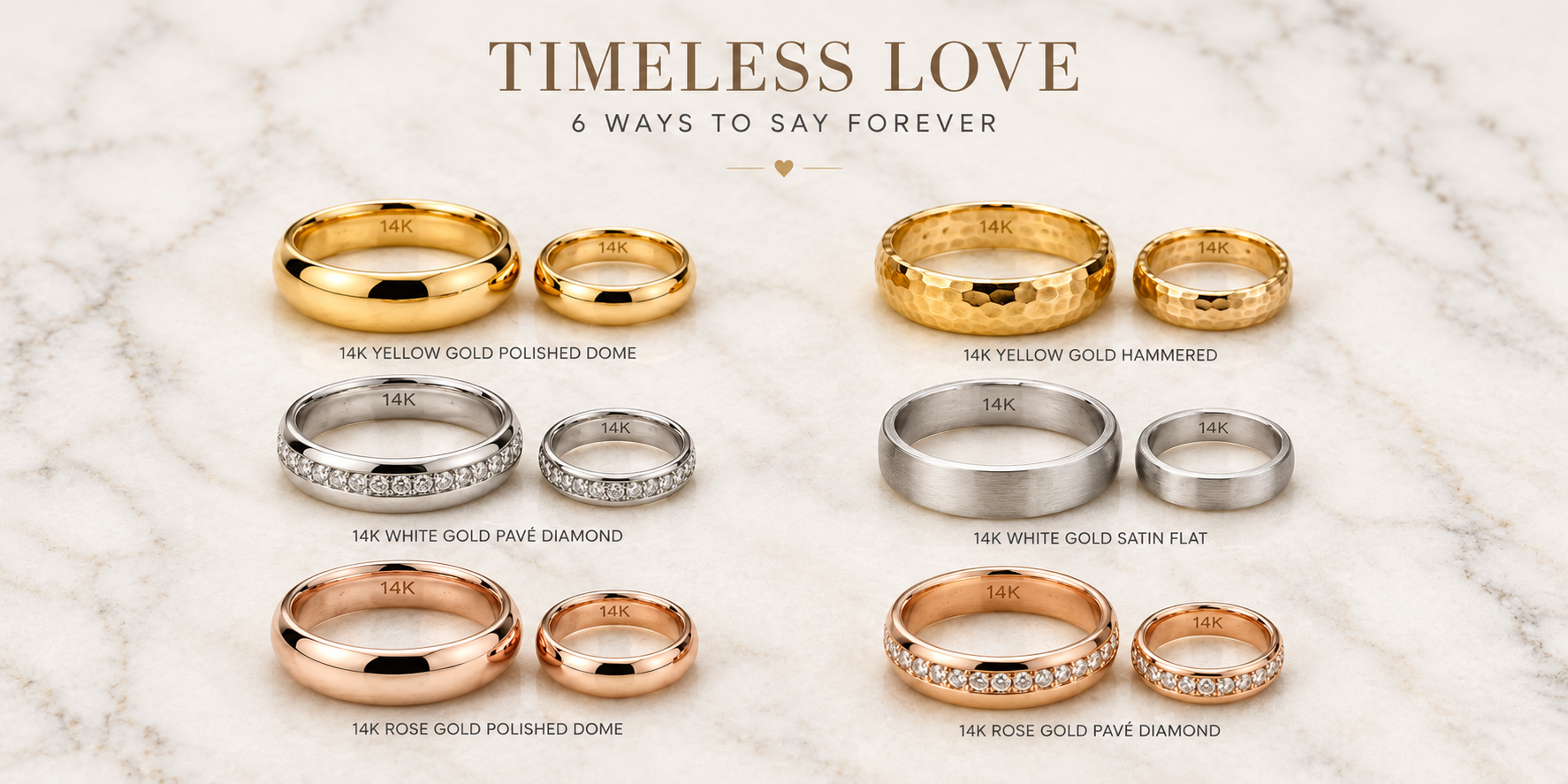
Frequently Asked Questions
Q: Which gold colour is most popular for his and hers wedding bands in 2026?
A: Rose gold is the most-searched gold tone in 2026 — search volume is up 31% year-on-year. White gold remains the most popular choice when one partner has a white gold engagement ring, as matching metals is the most important pairing rule. Yellow gold is experiencing a strong renaissance, particularly among couples who want a more traditional or warm aesthetic. All three are equally valid — the right choice depends on your engagement ring metal and personal preference.
Q: Should his and hers wedding bands be the same gold colour?
A: Matching gold colour creates the most cohesive look and is the most traditional approach. However, two-tone sets and mixed-colour pairs are increasingly popular — particularly when his and hers have different preferences, or when her engagement ring is a different metal to what he wants in his band. If choosing different colours, the most successful combinations are: yellow gold his + rose gold hers (warm tones complement), or white gold his + yellow gold hers (contrast with unity).
Q: What is the difference between 14K and 18K gold for wedding bands?
A: 14K gold contains 58.3% pure gold and 41.7% alloy metals (usually silver, copper, zinc). It is harder, more scratch-resistant, and more affordable. 18K gold contains 75% pure gold and is softer,
richer in colour — deeper yellow, deeper rose — and slightly more expensive. For daily-wear wedding bands, most professionals recommend 14K for its durability. 18K is worth the upgrade if colour richness and prestige are priorities and the rings will be worn carefully.
richer in colour — deeper yellow, deeper rose — and slightly more expensive. For daily-wear wedding bands, most professionals recommend 14K for its durability. 18K is worth the upgrade if colour richness and prestige are priorities and the rings will be worn carefully.
Q: How long does white gold last before needing re-plating?
A: The rhodium plating on white gold typically lasts 12–24 months with daily wear before the underlying gold alloy (which has a slightly yellowish tone) begins to show through. Re-plating is a standard service at any jeweler, costs $40–$80 per ring, and takes 1–3 days. High-polish white gold shows rhodium wear faster than satin-finish, as the polished surface makes any tonal variation more visible. If you want a naturally white metal that never needs re-plating, platinum is the alternative.
Q: Can gold wedding bands be resized?
A: Yes — all gold wedding bands (10K, 14K, 18K in all colours) can be resized by a jeweler. Resizing is possible one to two sizes up or down without affecting the ring’s integrity. Plain bands resize most easily. Engraved bands, diamond pavé bands, and full eternity bands are more complex to resize — full eternity bands (diamonds all the way around) cannot be resized at all. When in doubt about size,
order half a size larger and have it professionally sized down.
order half a size larger and have it professionally sized down.
Q: How do I match gold wedding bands with a diamond engagement ring?
A: Match metals where possible: a 14K white gold engagement ring is best paired with 14K white gold wedding bands. If she has a yellow gold engagement ring, yellow or rose gold wedding bands work best. Width matters too: her wedding band should be narrower than or equal to the width of her engagement ring shank (typically 1.5–2.5mm) for proportional stacking. If there is a gap between the bands when stacked, consider a contoured or curved shadow band designed to nestle against the engagement ring profile.
Q: How do I care for gold wedding bands?
A: Clean monthly with warm water, a drop of dish soap, and a soft baby toothbrush. Gentle scrubbing removes the oils, lotion, and soap that dull gold’s surface. Rinse thoroughly and dry with a lint-free cloth. For white gold: have rhodium re-plating done when you notice the colour warming toward yellow — typically every 12–24 months. Remove gold bands during heavy manual work, weight training, or swimming (chlorine in pools reacts with gold alloys over time). Annual professional cleaning and inspection is recommended.
Related Guides
- His & Hers Diamond Wedding Bands — Add diamonds to your gold set
- Best His & Hers Wedding Bands 2026 — Top 15 overall picks
- His & Hers Wedding Bands by Metal Type — Gold vs platinum vs alternatives
- White Gold vs Yellow Gold vs Rose Gold — Deep comparison guide
- His & Hers Wedding Bands with Engraving — Personalise your gold bands
- 20 Unique His & Hers Wedding Bands — Non-traditional designs
- Mistakes to Avoid When Buying Wedding Bands — Complete guide
- Why Wearing a Wedding Band Matters
- Shop All His & Hers Wedding Band Sets
- Shop Men’s Gold Wedding Bands
- Shop Women’s Gold Wedding Bands