

A wedding band is the one piece of jewelry you wear every day of your marriage. Adding diamonds to that band isn't extravagance — it's intention.
His and hers diamond wedding bands tell a different story to plain metal bands. The diamonds catch light in a meeting room, at the dinner table, at the school gate. Every time they do, they mark the moment you and your partner chose each other.
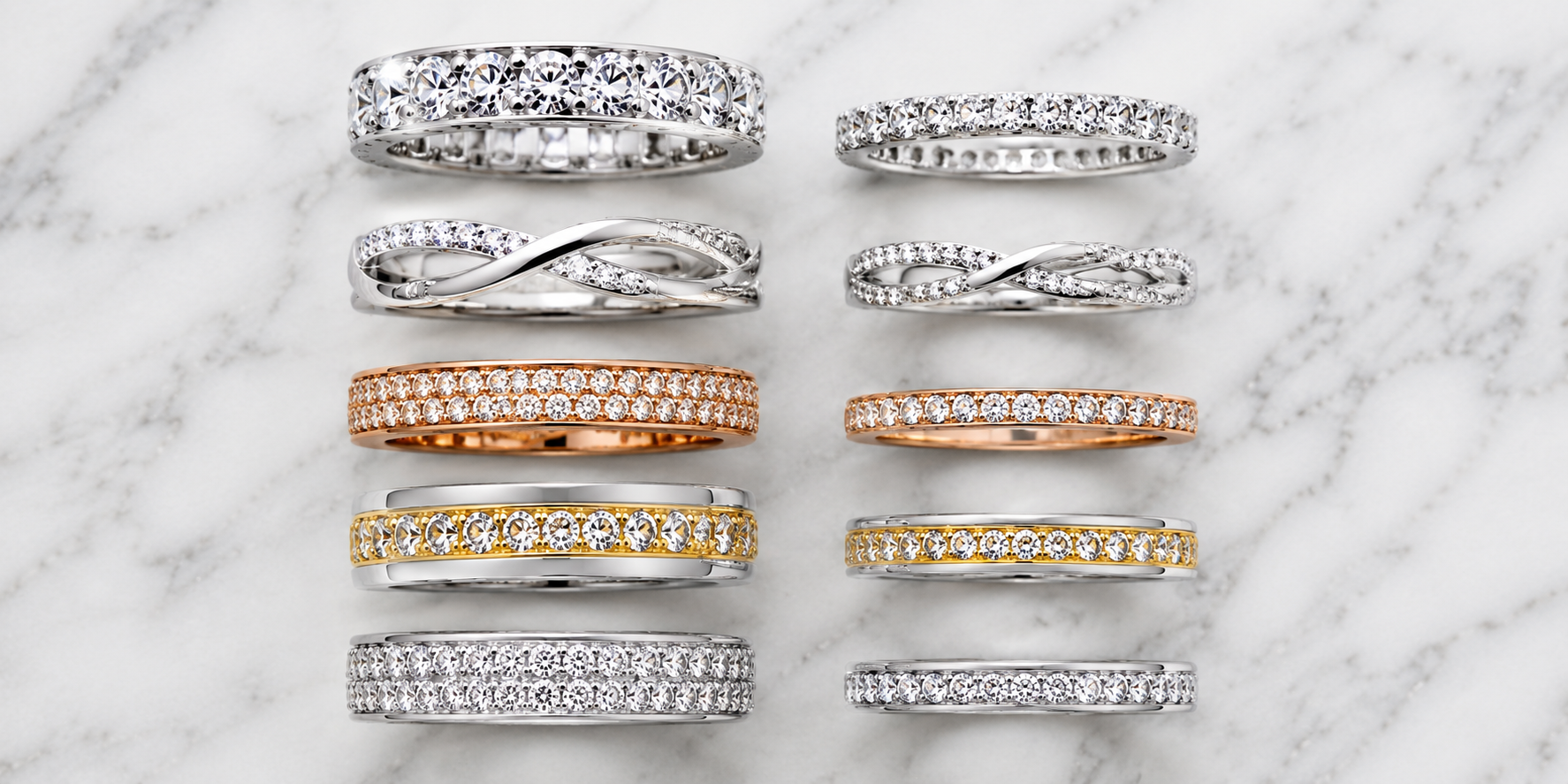
In this guide, we've curated 15 matching diamond wedding band sets across every major style — from classic pavé in 14K white gold to bold eternity bands in platinum to subtle flush-set diamonds for active lifestyles. We've also included a complete buying guide covering cut, clarity, carat weight, and the six diamond setting styles so you understand exactly what you're investing in.
Not sure which metal pairs best with diamonds? Jump to our metal selection guide or read on for the full matched-set recommendations.
What to Know Before You Buy Diamond Wedding Bands
Diamond engagement rings are selected for size and centre-stone drama. Diamond wedding bands follow different rules — here are the four things that matter most:
4 Factors That Matter in Diamond Wedding Bands
Total Carat Weight (TCW)
Wedding bands don't have a single centre diamond — they have many small stones. TCW is the combined weight of all diamonds. For bands, 0.25–0.50 ctw produces visible sparkle. 0.50–1.00 ctw is bold. 1.00+ ctw is eternity-band level. More carat weight = more sparkle and higher price.
Cut Quality
In wedding bands, diamond cut determines how much the band 'lights up'. Round brilliant cuts maximise sparkle. Baguettes create a cleaner architectural line. Single cuts are used in very small pavé diamonds. Always prioritise cut grade over carat weight.
Setting Security
You'll wear this ring daily. Prong settings are beautiful but more vulnerable to snagging and wear. Channel, bezel, and flush settings offer better protection and lower maintenance for active lifestyles.
His Band Approach
Men's diamond bands are usually more subtle — a channel row, pavé groove, or single accent diamond. Wider bands with minimal diamonds look intentional and masculine rather than decorative.
Classic Diamond His and Hers Sets (1–5)
These five sets are the foundation of our collection — timeless designs in white gold that will be just as beautiful in 30 years as they are today.
His band: 7mm 14K white gold with a single row of pavé diamonds along the centre. 0.15 ctw round brilliant cut, G–H colour, VS2–SI1 clarity. Comfort-fit interior.
Her band: 3mm 14K white gold full pavé band. 0.50 ctw round brilliant G–H, VS2–SI1. Classic dome profile, comfort-fit. Pairs perfectly with a solitaire engagement ring.
Why couples choose this: The pavé technique creates a river of light along the band. Her half-eternity band is one of the most universally flattering designs ever made. His subtle pavé centre reads as jewellery-aware without being showy.
Perfect for: Couples who want a timeless, jewellery-house aesthetic. Works with any engagement ring style.
His band: 7mm 14K yellow gold with a recessed diamond channel along the centre. 0.12 ctw round brilliant, G–H, SI1. Flat comfort-fit, no snag risk.
Her band: 3.5mm 14K yellow gold full channel-set band. 0.40ctw round brilliant, G–H, SI1. Low-profile design sits flat against engagement ring.
Why couples choose this: Channel setting is the most practical diamond setting — diamonds are fully protected by the surrounding metal walls. Zero maintenance required, no prongs to catch or bend. The yellow gold warms the diamonds and creates a classic bridal look.
Perfect for: Active couples, medical professionals, or anyone who uses their hands heavily at work.
His band: 8mm 14K white gold with five bezel-set round brilliant diamonds spaced evenly. 0.10ctw total, G colour, VS1. Bold masculine profile, flat.
Her band: 4mm 14K white gold seven-diamond bezel band. 0.35ctw round brilliant, F–G, VS1–VS2. The bezels create a graphic, intentional look.
Why couples choose this: Bezel setting is the only diamond setting with zero snag risk. Each diamond is completely surrounded by metal — the setting is essentially a tiny platinum cup. The modern, architectural aesthetic is one of 2026's strongest trends.
Perfect for: Design-minded couples who want a contemporary look. Also ideal for very active professions.
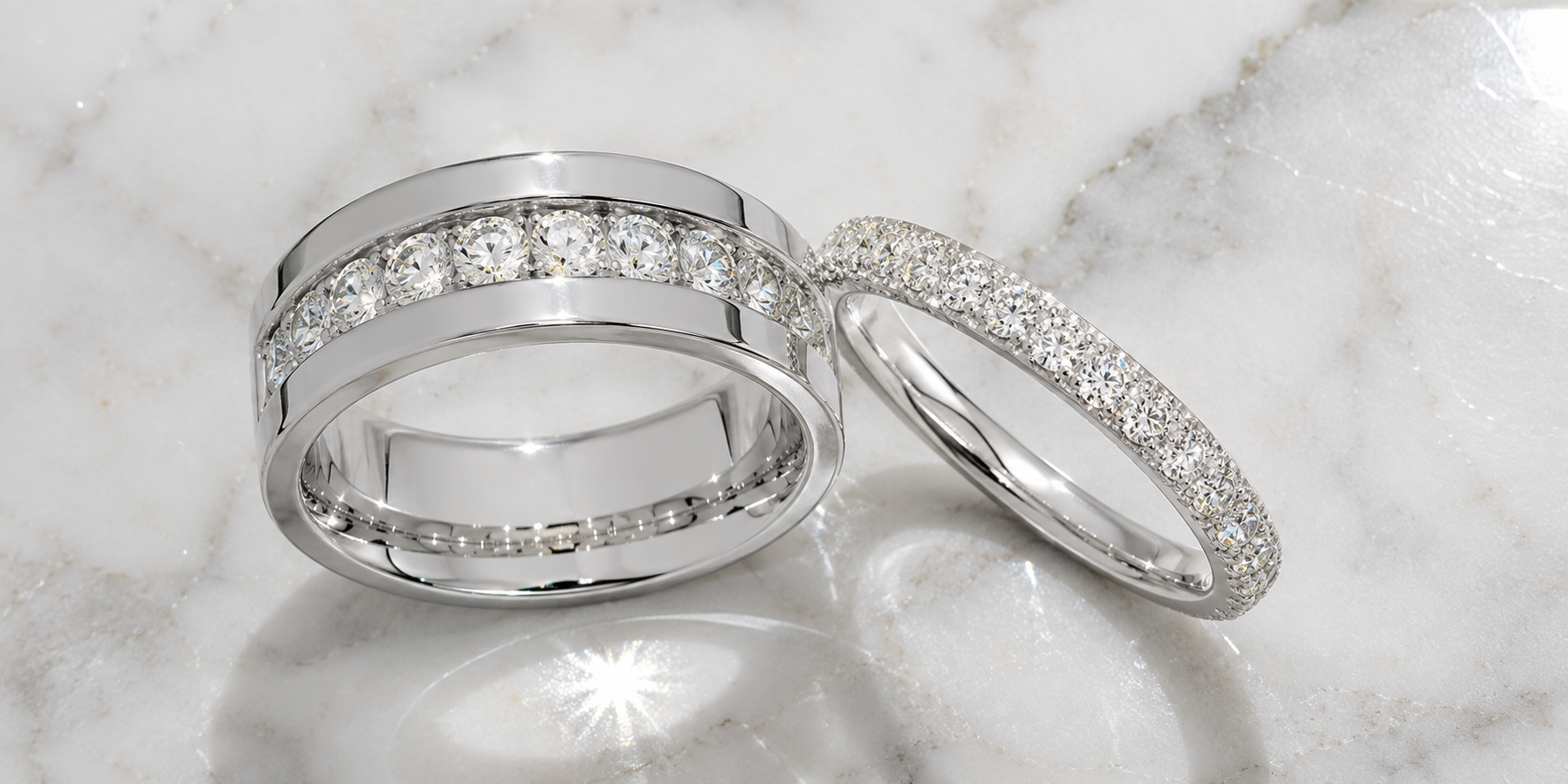
His band: 8mm 14K white gold with three flush-set round diamonds spaced evenly. 0.08ctw total, G–H, SI1. Completely smooth exterior — no texture whatsoever.
Her band: 4mm 14K white gold with five flush-set diamonds. 0.25ctw G–H, VS2–SI1. The smooth surface looks clean and minimal, diamonds visible as subtle sparkle points.
Why couples choose this: Flush setting is the most wearable diamond setting for daily life. The ring exterior is completely smooth — it cannot catch on gloves, workout equipment, or fine fabrics. The diamonds are visible as subtle sparkle points rather than prominent stones.
Perfect for: Athletes, surgeons, chefs, parents, or anyone who wants diamond bands they can truly wear every moment.
His band: 8mm 14K white gold with three prong-set round brilliant diamonds. 0.20ctw total, F–G colour, VS1. The three diamonds represent past, present, future.
Her band: 4mm 14K white gold with seven prong-set round brilliant diamonds graduating in size. 0.75ctw total, F–G, VS1–VS2. The raised stones maximise light return and visible brilliance.
Why couples choose this: Prong setting lifts each diamond above the band surface, maximising the amount of light that enters and exits the stone. This produces the most visible sparkle of any setting style — her band in particular will catch attention across a room.
Perfect for: Couples who want their bands to be noticed. Especially striking in direct sunlight or well-lit rooms.
Gold His and Hers Diamond Band Sets (6–10)
Gold diamond bands are the most traditional and emotionally resonant choice. The warmth of gold against the brilliance of diamonds is a combination that has defined wedding jewelry for centuries.
His band: 7mm 18K yellow gold with a single channel-set diamond row continuing all the way around the band. 0.30ctw round brilliant, H–I colour, SI1. The 18K gold has a richer, deeper yellow than 14K.
Her band: 2.5mm 18K yellow gold full eternity band. 1.00ctw channel-set round brilliant, H–I, VS2. Circles the finger with an unbroken ring of diamonds — the most romantic design in the collection.
Why couples choose this: A full eternity band is the ultimate symbol of unending love. The diamonds go all the way around — there is no beginning and no end. His half-eternity provides a complementary masculine version. The 18K yellow gold setting warmly frames the diamonds.
Perfect for: Couples who want maximum symbolism. An eternity band makes the most powerful visual statement in the full collection.
His band: 7mm 14K rose gold with a single row of pavé diamonds. 0.12ctw round brilliant, I–J colour, SI1. The warm rose gold amplifies the warm tones in the diamonds beautifully.
Her band: 3.5mm 14K rose gold half-eternity pavé band. 0.45ctw round brilliant, I–J, SI1. Rose gold is the most flattering metal against most skin tones — it warms the hand.
Why couples choose this: Rose gold is the most searched wedding band metal of 2026. The warm rose tone pairs particularly well with lower-colour diamonds (I–J range) — the metal masks any yellow tint and the diamonds appear whiter. This lets couples buy better cut quality at the same budget.
Perfect for: Couples who love the romantic rose gold aesthetic or who want to maximise diamond sparkle on a budget.
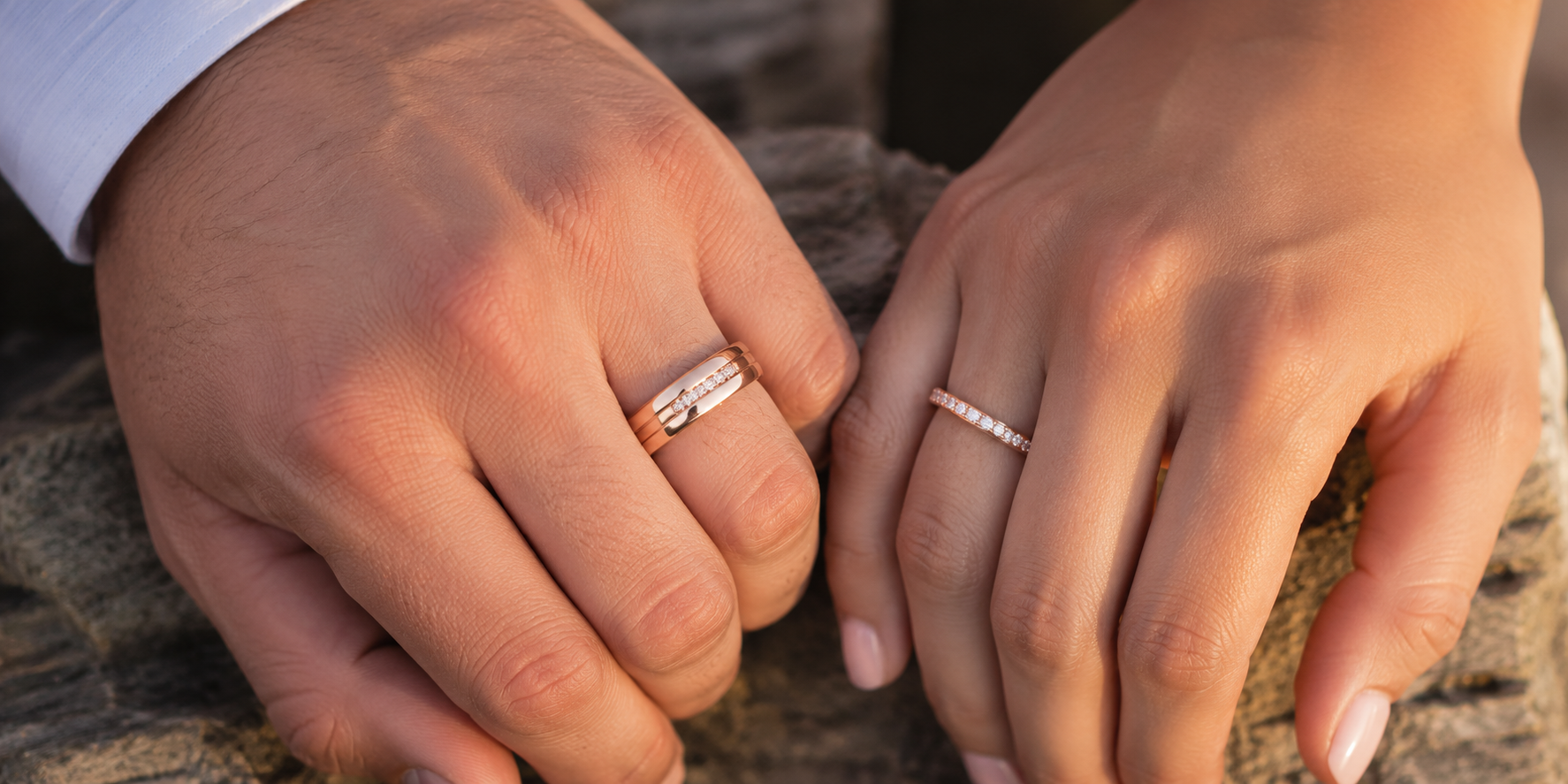
His band: 8mm 14K white gold domed band with a micro-pavé diamond row. 0.10ctw G–H colour, VS1. The dome profile gives a more substantial look on wider male fingers.
Her band: 3mm 14K white gold micro-pavé dome band. 0.38ctw G–H, VS2–SI1. The slight dome curves naturally with the finger for exceptional all-day comfort.
Why couples choose this: Micro-pavé uses smaller diamonds set more tightly than standard pavé — creating a denser, more glittering surface. The domed profile is one of the most comfortable band shapes for daily wear as it reduces contact pressure at the sides of the finger.
Perfect for: Couples prioritising wearability and comfort alongside sparkle.
His band: 8mm two-tone band: white gold shank, yellow gold centre groove with pavé diamonds. 0.15ctw round brilliant, H–I, SI1. The contrast of the two metals is architectural and sophisticated.
Her band: 3.5mm two-tone: white gold band, yellow gold pavé channel. 0.50ctw round brilliant, H–I, VS2. A versatile design that pairs with both yellow and white gold engagement rings.
Why couples choose this: Two-tone design is a growing trend in 2026 — search volume for “two-tone wedding bands” is up 44% YoY. The yellow gold diamond setting warms the stones' appearance while the white gold band keeps the overall look modern. It's also the most versatile design for pairing with either a yellow or white gold engagement ring.
Perfect for: Couples who have different metal preferences, or those who want a band that pairs with any engagement ring.
His band: 8mm 14K white gold with channel-set diamonds flanked by hand-applied milgrain (tiny bead-rolled) borders. 0.12ctw H–I, SI1. The milgrain detail references antique jewelry craftsmanship.
Her band: 3mm 14K white gold pavé half-eternity with milgrain edges. 0.45ctw H–I, VS2. The milgrain creates a lacy, intricate border that gives the band a distinctive vintage character.
Why couples choose this: Milgrain is a hand-finishing technique — a jeweler rolls a tiny toothed wheel along the metal edge to create a beaded border. It was a hallmark of Edwardian and Art Deco jewelry. On a modern band it reads as handcrafted and unique, adding detail that catches the eye even before the diamonds do.
Perfect for: Couples with vintage, antique, or Art Deco aesthetic preferences. Especially beautiful paired with vintage-style engagement rings.
Eternity & Platinum His and Hers Diamond Sets (11–15)
For couples who want the finest materials and the most generous diamond coverage, these five sets represent the pinnacle of our his and hers diamond collection.
His band: 8mm platinum with 0.50ctw channel-set full eternity of round brilliants. E–F colour, VS1. Platinum's natural white colour needs no rhodium plating — ever.
Her band: 3mm platinum full eternity pavé band. 1.50ctw round brilliant, E–F, VS1–VS2. Unbroken ring of diamonds. Platinum's hypoallergenic properties make it the premium medical-grade choice.
Why couples choose this: Platinum is the only metal that is naturally white — white gold gets its colour from rhodium plating, which wears off and needs renewing. Platinum's colour is permanent. Combined with the highest-grade diamonds (E–F, VS1), this set is the most brilliant and the most durable in the collection.
Perfect for: Couples who want the best of everything and a set that will look identical in 50 years.
His band: 8mm 14K white gold with a pavé half-eternity front row. 0.22ctw round brilliant, G–H, VS2. The back of the band is plain metal for comfortable wear.
Her band: 3.5mm 14K white gold half-eternity pavé. 0.75ctw round brilliant, G–H, VS1–VS2. Half eternity displays diamonds exactly where they're seen — the top half.
Why couples choose this: Half-eternity is the most practical eternity design. The diamonds only appear on the top half of the band — where they're visible. The plain metal back is more comfortable to wear daily, and the band can be sized (full eternity bands cannot be resized). You get all the visual impact of an eternity band with none of the practical compromises.
Perfect for: Couples who love the eternity band look but want a band that can be resized in future.
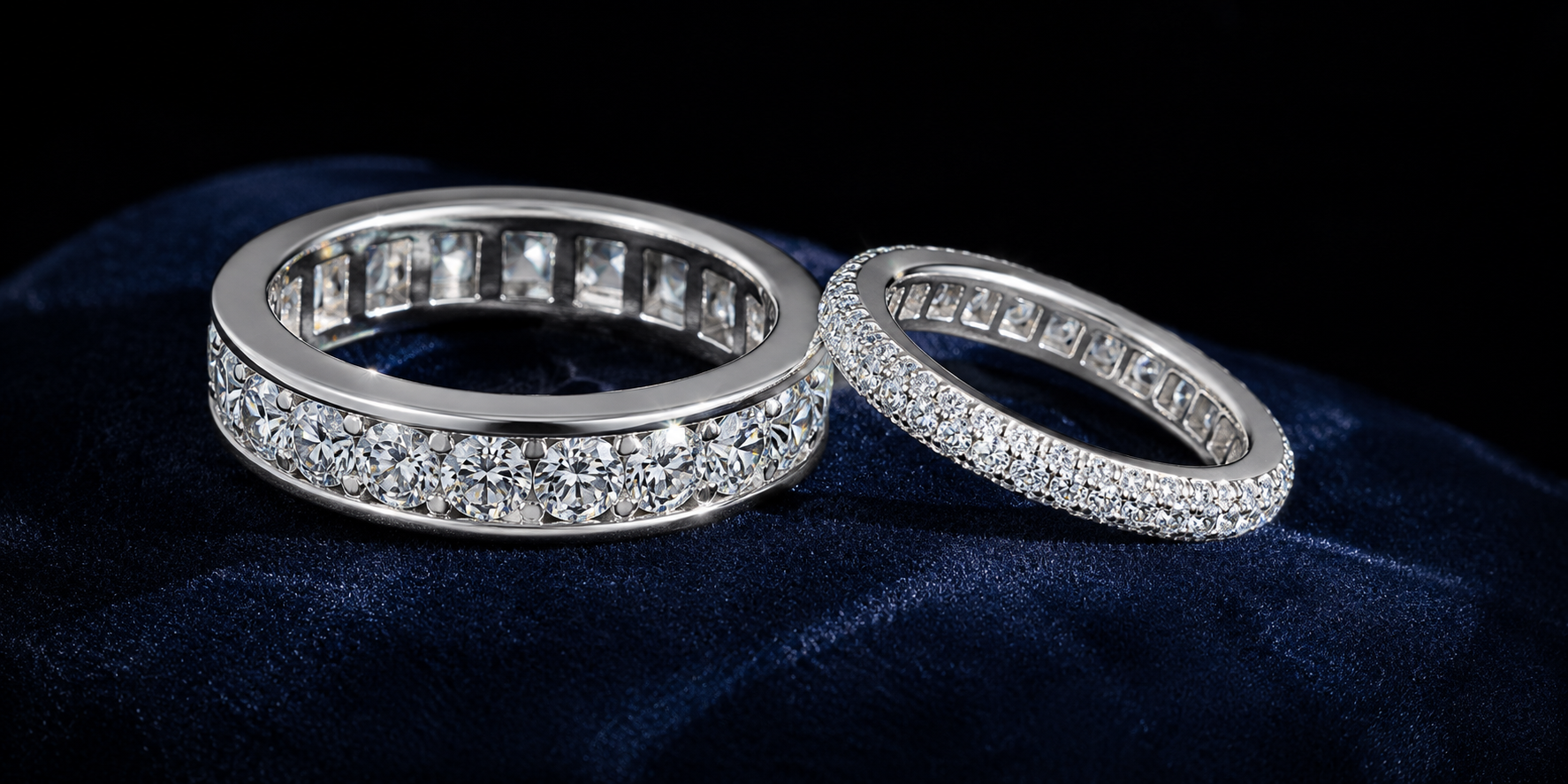
His band: 8mm 14K white gold cathedral band — the metal arches dramatically toward the diamond row at the centre. 0.18ctw round brilliant G–H, VS2. The arching profile gives the ring architectural height.
Her band: 4mm 14K white gold cathedral pavé band. 0.55ctw round brilliant G–H, VS1–VS2. The slight arch elevation presents the diamonds at their most prominent angle.
Why couples choose this: Cathedral setting raises the diamond row on arching metal “flying buttresses” — a construction borrowed from Gothic architecture. The elevation maximises how the diamonds catch light at different viewing angles. It's one of the most photographed ring profiles — the arch creates a natural shadow beneath the stones that adds depth to photographs.
Perfect for: Couples who love architectural aesthetics and want bands that photograph exceptionally well.
His band: 8mm 14K white gold curved band with a slight convex profile and pavé diamond row. 0.12ctw G–H, VS2. The curve allows the band to sit flush against a solitaire engagement ring.
Her band: 3.5mm 14K white gold curved shadow band. 0.40ctw pavé G–H, VS2. Designed to curve around a centre-set engagement ring, creating a unified stacking look.
Why couples choose this: A shadow band is specifically designed to wrap around the profile of an engagement ring — solving the most common frustration of wedding band shopping: the gap between band and engagement ring. Both rings nest together as one piece when worn, creating a bridal set appearance.
Perfect for: Anyone who wears or plans to wear an engagement ring alongside the wedding band. The most practical design for stacking rings.
His band: 8mm 14K white gold twisted band — the metal ribbons twist along the length, with pavé diamonds set into the raised ribbon. 0.20ctw round brilliant F–G, VS2. Bold, sculptural, immediately distinctive.
Her band: 4mm 14K white gold twisted pavé diamond band. 0.60ctw round brilliant F–G, VS1–VS2. The twist gives the band movement and dimension — it changes as the hand moves.
Why couples choose this: The twisted band profile is the most distinctive design in the collection. The rotation of the band means the diamonds face slightly different directions at each point — creating multi-angle sparkle that a straight band cannot match. His wider twisted band is one of the most genuinely striking men's wedding bands available.
Perfect for: Couples who want their bands to be truly unique and to stop people mid-conversation.
Diamond Setting Styles Explained — Which Is Right for You?
The setting style determines how your diamonds are held, how they sparkle, how much maintenance they need, and how they wear over decades. Here is the complete comparison:
| Setting Style | Appearance | Diamond Security | Ideal For Her | Ideal For Him | Price Impact |
|---|---|---|---|---|---|
| Pavé | Row of tiny diamonds along band surface | High — bezel-held | Full bands, eternity rings | Occasional pavé groove | +$400–$1,200 |
| Channel Set | Diamonds recessed in a channel groove | Very High — no prongs exposed | Classic look, active lifestyle | Men's channel bands | +$300–$900 |
| Prong Set | Diamonds raised on individual prongs | Moderate — prongs can catch | Solitaire-style bands, vintage | Rarely used | +$200–$800 |
| Bezel Set | Each diamond fully wrapped in metal | Highest — zero snag risk | Active lifestyles, low-profile | Men's bezel accents | +$300–$1,000 |
| Flush/Burnish | Diamond sits flush with metal surface | Highest — fully set in metal | Minimalist look | Most popular for his diamond band | +$150–$600 |
| Bar Set | Diamonds held by vertical metal bars | High — open sides show diamond depth | Modern, architectural look | Occasional bar band | +$300–$900 |
“The conversation I have most often is about setting choice versus carat weight. Couples consistently get more sparkle from better cut quality in a well-chosen setting than from larger diamonds in the wrong setting. A 0.25ctw pavé band in G colour, VS2, will outshine a 0.50ctw in a setting that traps light.”
— Rachel Stern, GIA Graduate Gemologist, 16 years designing bridal jewelry collections
Best Metals for Diamond Wedding Bands — Complete Guide
The metal you choose affects the diamonds' appearance, the band's durability, and the maintenance required over a lifetime of daily wear.
| Metal | Best Diamond Colour With It | Durability | Resizable? | Price (Set) | Best For |
|---|---|---|---|---|---|
| 14K White Gold | D–J (colourless to near-colourless) | ★★★★☆ | Yes | $1,100–$3,500 | Most popular pairing — white metal amplifies diamond brilliance |
| 18K White Gold | D–H (colourless best) | ★★★☆☆ | Yes | $1,400–$4,500 | Whiter, purer look; re-rhodium plating needed every 1–2 years |
| 14K Yellow Gold | J–M (warm tones complement gold) | ★★★★☆ | Yes | $1,100–$3,200 | Classic and warm; lower-colour diamonds look better in yellow |
| 18K Yellow Gold | I–M (warm-toned diamonds ideal) | ★★★☆☆ | Yes | $1,400–$4,000 | Richest gold look; prestige choice |
| 14K Rose Gold | J–M (warmer tones complement rose) | ★★★★☆ | Yes | $1,100–$3,400 | Romantic, trending; diamonds appear warmer in rose gold |
| Platinum | D–G (best with colourless diamonds) | ★★★★★ | Yes | $2,200–$6,500 | Naturally white, no re-plating needed; premium for life |
“I always ask couples what engagement ring she has before recommending a metal for the wedding bands. Matching metals between the engagement ring and wedding band is more important than most couples realise — mismatched metals create a visual discontinuity that can make expensive rings look like they were bought separately and don't belong together.”
— Thomas Reeves, Master goldsmith, former senior designer at a New York bridal jewelry house, 24 years' experience
For a complete breakdown of gold types — including the difference between 10K, 14K, and 18K — see our guide to white gold, yellow gold, and rose gold wedding bands .
Shop His & Hers Diamond Wedding Bands
14K & 18K gold · Platinum · Pavé, channel, eternity & flush settings · Expert sizing guidance → Browse Our Full Diamond Band Collection →
Frequently Asked Questions
Q: What is a good carat weight for his and hers diamond wedding bands?
A: For her diamond wedding band, 0.25–0.50ctw gives clear visible sparkle in pavé or channel settings. 0.50–1.00ctw is considered a substantial band. 1.00+ctw is an eternity band level. For his band, 0.10–0.25ctw is typical — enough to be clearly visible as a diamond band without appearing costume-like. The most important factor is cut quality rather than carat weight — a well-cut 0.25ctw band outshines a poorly cut 0.50ctw band.
Q: Should his and hers diamond wedding bands match exactly?
A: Exact matching is not required — and in many cases not desirable. The most successful his and hers diamond sets share a design language: the same metal, the same diamond colour and clarity grade, and a complementary setting style and proportion. Her band is typically narrower (2.5–4mm) with more diamond coverage. His band is typically wider (6–9mm) with more subtle diamond placement. They should look like they belong to the same couple — not like identical copies of each other.
Q: What diamond quality should I choose for a wedding band?
A: For wedding bands, colour grade G–H and clarity grade VS2–SI1 is the professional sweet spot. In the small diamonds used in pavé and channel bands, inclusions at SI1 are not visible to the naked eye. Colour grades G–H appear white next to each other and in white or yellow gold settings. Going to F–G, VS1 adds cost with no visible benefit in most settings. Reserve D–F, IF–VS1 for platinum settings with colourless diamonds where colour differences are most visible.
Q: Can diamond wedding bands be resized?
A: Half-eternity and bands with diamonds only on the top half can be resized by a goldsmith, as the back of the band is plain metal. Full eternity bands (diamonds all the way around) cannot be resized — every position on the shank contains a diamond. If you choose a full eternity band, accurate ring sizing is critical. We offer professional ring sizing guidance with every purchase. When in doubt, size up by half — a slightly large band can be adjusted with a sizing ball insert.
Q: How do I stack a diamond wedding band with an engagement ring?
A: Matching metal is the most important rule — both rings should be the same metal (or at minimum, the same metal tone). Width compatibility is the second factor — a 3mm wedding band pairs naturally with a standard solitaire shank (typically 1.6–2mm), while a 4–5mm band may need a thicker shank engagement ring to look proportional. If there is a gap between your engagement ring and wedding band, consider a curved shadow band (see set #14) which is specifically designed to wrap around a solitaire profile.
Q: How do you care for diamond wedding bands?
A: Clean at home every 2–4 weeks with warm water, a drop of dish soap, and a soft baby toothbrush — gentle scrubbing removes the oils and lotion that accumulate behind and between diamonds and reduce sparkle. Professional ultrasonic cleaning and prong inspection by a jeweler is recommended annually. Remove bands during heavy manual work, weight training, or any activity involving impact. Store rings separately from harder gemstones (sapphire, moissanite) to prevent surface scratches on the gold shank.
Related Guides
- Best His & Hers Wedding Bands 2026 — Top 15 overall picks across all metals
- His & Hers Wedding Bands by Metal Type — White gold, yellow gold, platinum compared
- White Gold vs Yellow Gold vs Rose Gold — Which metal is right for your diamonds?
- His & Hers Wedding Bands with Engraving — Personalise your diamond bands
- 20 Unique His & Hers Wedding Bands — Non-traditional designs
- Mistakes to Avoid When Buying Wedding Bands — Complete buying guide
- Why Wearing a Wedding Band Matters — The meaning behind the ring
- Shop All His & Hers Wedding Band Sets
- Shop Men's Wedding Bands
- Shop Women's Wedding Bands


