

Wedding bands are the most worn piece of jewelry you will ever own. Unlike an engagement ring, which is often chosen by one person, wedding bands require two people to agree on something they will both wear every day for the rest of their lives.
That's a decision worth doing properly.
This guide walks you through every decision — metal, karat, width, finish, diamonds, budget, and how to match your engagement ring — in the order you should make them. By the end, you'll know exactly what to buy and why.
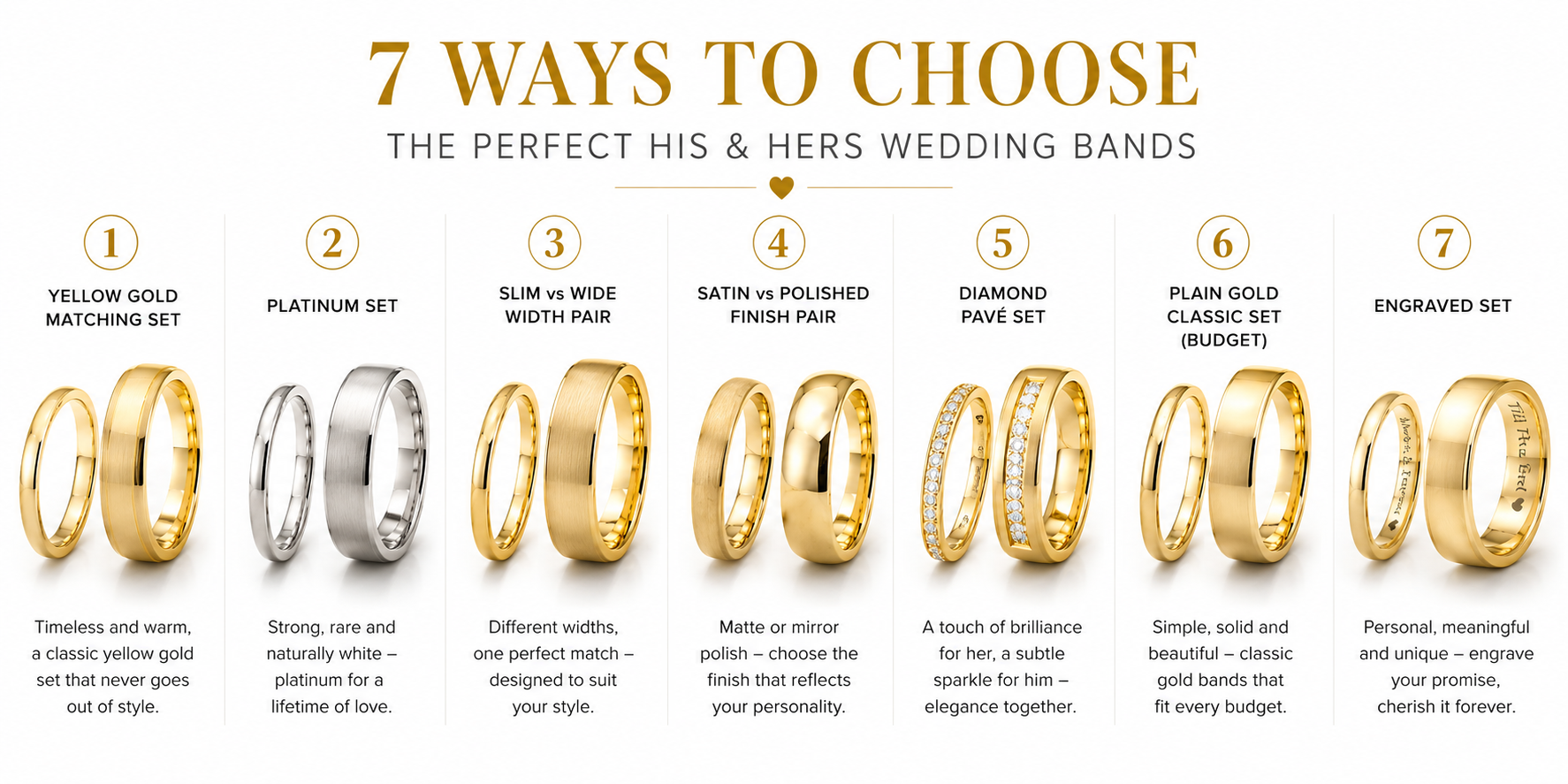
The 7 Decisions — In Order
- Step 1: Match the engagement ring metal first
- Step 2: Choose your karat level
- Step 3: Decide on his width and her width
- Step 4: Choose a finish — polished, satin, or hammered
- Step 5: Decide on diamonds — yes, no, or accent only
- Step 6: Set your budget
- Step 7: Personalise with engraving
Step 1: Match the Engagement Ring Metal First
The single most important rule in wedding band selection: match the metal of the engagement ring. Breaking this rule is the most common and most visible mistake couples make.
Why metal matching matters
When a yellow gold wedding band sits against a white gold engagement ring, the colour contrast draws the eye immediately. In photographs, at the dinner table, in a handshake — the mismatch is visible to anyone who looks. It signals that the rings were not chosen together.
The one exception: deliberately two-tone designs, where both metals appear intentionally in both rings. This works because the rings are clearly designed to include both colours — it reads as a choice, not a mismatch.
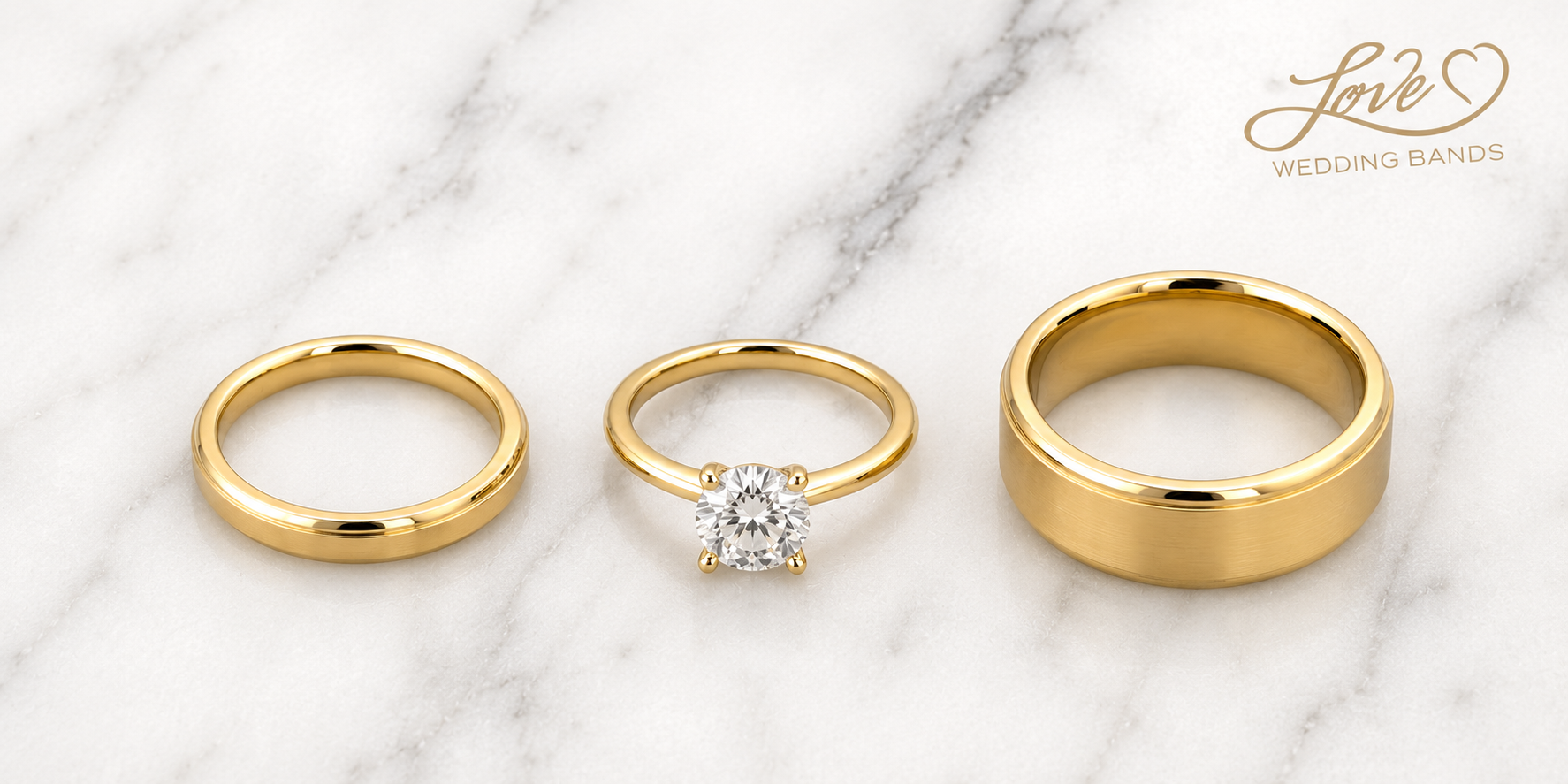
Which metal should you choose?
She has a white gold engagement ring
→ Choose 14K or 18K white gold for both bands. This is the most important matching decision. Her band must sit against her engagement ring daily — different metals will be visually obvious.
She has a yellow gold engagement ring
→ Choose 14K or 18K yellow gold. Yellow gold wedding bands with a yellow gold engagement ring create a clean, unified bridal stack.
She has a rose gold engagement ring
→ Choose 14K or 18K rose gold. Rose gold is the fastest-growing bridal metal — matching it confirms a deliberate aesthetic.
She has a platinum engagement ring
→ Choose platinum for both, or 14K/18K white gold as a close match. Rhodium-plated white gold reads the same as platinum at a distance.
No engagement ring to match
→ Choose freely. Start with Step 2 (karat) and Step 3 (width) and let those decisions guide the metal.
See our complete gold colour comparison guide for the full breakdown of yellow, white, and rose gold in every karat.
Step 2: Choose Your Karat Level
Karat refers to the proportion of pure gold in the alloy. Higher karat = more gold = richer colour = softer metal. The choice between 14K and 18K is a balance of colour depth against durability.
| Metal | Colour | Durability | Resizable? | Re-plating? | Right For |
|---|---|---|---|---|---|
| 14K Yellow Gold | Warm medium yellow | Very high | Yes | No | Classic couples, active lifestyles |
| 14K White Gold | Bright white (rhodium) | Very high | Yes | Every 1–2 yrs | White/platinum engagement ring partners |
| 14K Rose Gold | Warm peachy-pink | Very high | Yes | No | Romantic aesthetic, flatters most skin tones |
| 18K Yellow Gold | Rich deep yellow | High | Yes | No | Luxury buyers, heirloom-quality investment |
| 18K White Gold | Purest white (rhodium) | High | Yes | Every 1–2 yrs | Premium diamond settings, white-metal purists |
| Platinum | Natural cool white | Highest | Yes | Never | Lifetime investment, naturally white forever |
“I ask every couple one question before recommending a karat: what do you do with your hands all day? A surgeon, a carpenter, and a lawyer all have different answers — and different karat recommendations. For daily manual work, 14K every time. For a desk professional who wants maximum gold richness, 18K is worth considering.”
— David Kimani, GIA Graduate Gemologist and goldsmith, 18 years in bespoke bridal jewelry
Quick rule: 14K vs 18K
- Choose 14K if: you use your hands at work, you exercise regularly, or you want maximum durability for daily wear.
- Choose 18K if: you want the richest, deepest gold colour and you'll wear the rings carefully.
- Choose Platinum if: you want a naturally white metal that never needs re-plating and you're making a lifetime investment.
Step 3: Choose Your Widths — His and Hers
Width is where most couples make their second mistake: choosing widths that are either too similar (making her ring look like a second men's band) or too different (making them look unrelated).
The natural proportional rule: his band should be approximately double the width of hers. This mirrors the natural size difference between male and female fingers and creates a clear visual pairing.
| His Width | Her Width | Overall Feel | Best Style | Notes |
|---|---|---|---|---|
| 4–5mm | 2–3mm | Ultra-slim, modern | Flat or petite dome | Architectural and minimalist. Increasingly popular in 2026. |
| 6mm | 3mm | Slim classic | Classic dome | Most versatile pairing. Works with any engagement ring profile. |
| 7–8mm | 3.5–4mm | Traditional | Dome, pavé, channel | The most popular his and hers proportion. Timeless balance. |
| 8–9mm | 4–5mm | Bold | Wide pavé, two-tone | Him: strong presence. Her: nearly full-eternity visual. |
| 10mm+ | 5–6mm | Statement | Carved, engraved | For broad fingers or those wanting maximum ring presence. |
“Width proportion is the invisible design principle that makes a his and hers set look like it was planned. When I see two bands that look like they belong together, it's almost always because the widths are proportional. When something looks off, it's usually because they're too similar in width.”
— Sarah Okonkwo, Bridal jewelry specialist, 14 years advising couples on ring selection
Width tip: match her wedding band to her engagement ring shank
Her wedding band will be stacked against her engagement ring every day. If her engagement ring shank is 1.8mm wide (standard solitaire), a 5mm wedding band will visually dominate and look out of proportion. A 3mm wedding band will sit as a natural complement.
Measure the width of her engagement ring shank before choosing wedding band width. When in doubt, go narrower — a too-thin band can be stacked with an additional band later. A too-wide band cannot be made narrower. Browse our sets by width
Step 4: Choose a Finish
The finish determines how the ring looks on day one — and how it continues to look over a lifetime of daily wear.
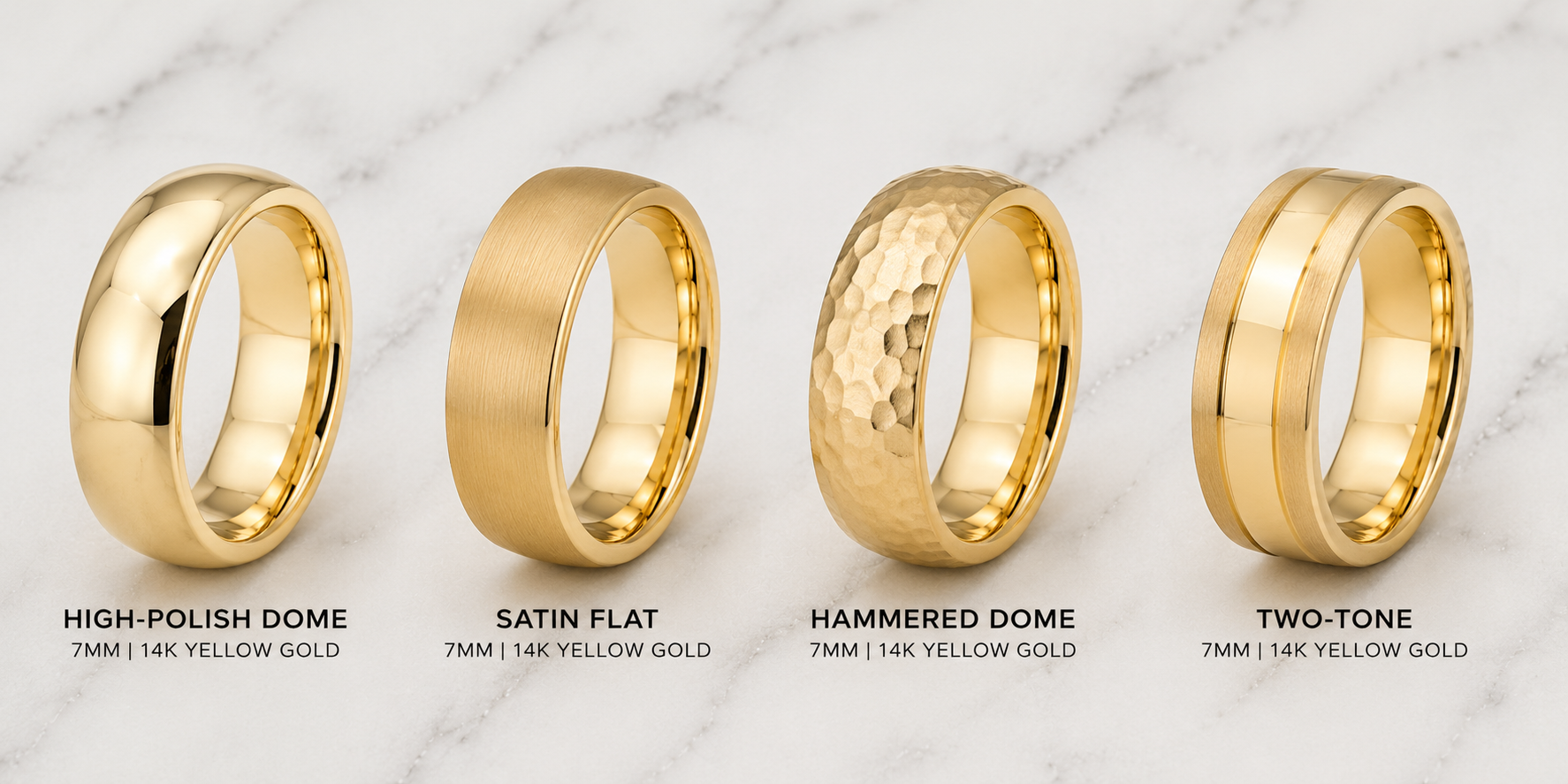
High-Polish
The classic mirror finish — the metal at its most reflective and colour-saturated. Shows the full warmth of gold or the brightness of platinum. Trade-off: shows micro-scratches from daily contact more readily than any other finish. Re-polishing by a jeweler every 2–3 years restores the original surface.
Best for: Couples in office or light-activity roles who prioritise the classic look. Also for those who intend to re-polish regularly.
Satin / Brushed
A directional matte finish created by brushing the metal surface with a fine abrasive. The resulting parallel micro-lines give the metal a warm, velvety appearance. Crucially: new micro-scratches blend into the existing texture rather than standing out. The ring looks consistent for years without maintenance.
Best for: Active couples, professionals who use their hands, anyone who wants low-maintenance daily wear. The most practical finish for a ring worn constantly.
Hammered
An organic, faceted texture created by pressing a hammer tool repeatedly into the metal surface. Each ring has a slightly unique pattern. The multiple small facets catch light from many angles simultaneously, creating a dynamic shimmer rather than a static shine.
Best for: Couples who want an artisan, hand-crafted aesthetic. Also excellent at hiding wear — the random facets make any additional marks invisible.
Two-Tone (Polish + Satin)
Combining a polished centre channel with satin-brushed edges — or vice versa — on a single band. The contrast between finishes creates visual depth and texture. A popular 2026 design choice.
Best for: Couples who want visual complexity without adding gemstones. Works in any metal.
Step 5: Diamonds — Yes, No, or Accent Only?
Diamond wedding bands are chosen by 72% of couples in 2026, up from 61% in 2022. But the right answer is entirely personal — a plain gold band is not a lesser choice. It is a different one.
No diamonds — plain metal
The most traditional and most enduring choice. A plain gold band lets the marriage itself speak. It ages perfectly and requires no stone maintenance. Many couples who choose plain bands on the wedding day upgrade with diamonds on a significant anniversary.
Diamonds on her band only
The most common diamond configuration. Her pavé or channel band sparkles; his complementary plain or accent band reads as intentional and masculine. The set is clearly matched — different in detail, unified in design.
Diamond accent on both
A single row of channel or flush-set diamonds on his band answers the diamonds on hers. His diamonds are more subtle — 0.10–0.20 ctw — but the symmetry of both partners wearing diamonds gives the set a completeness that one-sided configurations don't have.
Full diamond eternity
The most generous diamond configuration — diamonds continuing all the way around both bands. A statement choice that represents maximum investment in the rings. Note: full eternity bands cannot be resized. Accurate sizing is essential.
If you choose diamonds, read our complete his and hers diamond wedding bands guide before selecting a setting style.
Step 6: Set Your Budget — What Each Range Gets You
| Budget (Both Rings) | Best Metal Option | Best Style | What You Get |
|---|---|---|---|
| $1,100–$1,500 | 14K Yellow or Rose Gold | Classic plain dome | Solid 14K gold plain bands in any colour — the most timeless and practical choice |
| $1,500–$2,200 | 14K White Gold | Satin or diamond accent | White gold with satin finish or subtle diamond accent on her band |
| $2,200–$3,200 | 14K Gold any colour | Diamond pavé or half-eternity | Her diamond pavé half-eternity with his matching plain or accent band |
| $3,200–$5,000 | 18K Gold or Platinum | Diamond eternity | Full eternity or platinum bands — the premium tier with maximum longevity |
| $5,000+ | Platinum | Platinum eternity or bespoke | Platinum with high-grade diamonds — a lifetime investment in the finest materials |
“The most important budget insight I give couples: spend proportionally. Her ring typically costs more because of diamond coverage. His ring is wider but simpler. A rough guide: 60–65% of the budget on her ring, 35–40% on his. Don't try to make them cost the same — make them look like a pair.”
— Rachel Stern, GIA Graduate Gemologist, 16 years in bridal jewelry
Step 7: Personalise with Engraving
Engraving is the final layer of personalisation that transforms a wedding band from jewelry into an object with a specific story. It costs relatively little but adds everything.
What to engrave — ideas by category
Date-based: Wedding date in numbers (06.14.26), Roman numerals (XIV·VI·XXVI), or written (June 14 2026)
Initials:Interlocking initials (E&J), his initials inside her ring + her initials inside his, or a combined monogram
Phrase or lyric:A phrase from your vows, the last line of a poem, a private phrase only you both understand — 20–30 characters
Coordinates:The GPS coordinates of where you got engaged, where you met, or where you'll marry
Simple word:One word that carries weight between you — ‘always’, ‘forever’, ‘mine’, ‘ours’, a word in another language
→ See our full engraving guide with character limits by band width
The Complete Decision Guide — Your Situation at a Glance
Use this table to find your recommended configuration based on your engagement ring and lifestyle:
| Your Situation | Recommended Metal | Best Finish | Her Width | His Width | Price Guide |
|---|---|---|---|---|---|
| She has a white gold solitaire | 14K White Gold | Polished dome | 3mm | 7mm | $1,300–$2,200 |
| She has a yellow gold ring | 14K Yellow Gold | Polished or satin | 3–4mm | 7–8mm | $1,200–$2,100 |
| She has a rose gold ring | 14K Rose Gold | Polished dome | 3mm | 7mm | $1,200–$2,000 |
| She has a platinum ring | Platinum or 14K White Gold | Polished flat | 3mm | 7–8mm | $1,800–$3,500 |
| Active lifestyle (both) | 14K Gold, any colour | Brushed satin | 3–4mm | 7–8mm | $1,200–$2,100 |
| Wants diamonds (her) | 14K White Gold | Pavé or channel | 3.5mm | 8mm | $1,600–$2,800 |
| Wants diamonds (both) | 14K White Gold | Pavé / flush | 3.5mm | 7–8mm | $1,800–$3,200 |
| Maximum premium | Platinum | High-polish flat | 3mm | 8mm | $2,500–$5,000 |
Shop His & Hers Wedding Bands — All Styles, All Metals
Expert sizing guidance · 14K & 18K gold · Platinum · Diamond · Engraved
→ Browse the Full Collection →
Frequently Asked Questions
Q: When should we start shopping for wedding bands?
A: Order wedding bands at least 8–10 weeks before your wedding date. This allows time for sizing, any custom engraving (add 2–3 weeks), and exchanges if the fit is not right. For platinum bands or engraved sets, order 12 weeks ahead. Do not leave it until the final few weeks — sizing errors and engraving queues are stressful to fix under time pressure.
Q: Do wedding bands have to match the engagement ring exactly?
A: The metal should match — same colour, ideally same karat. The style does not need to match. Her engagement ring can be a halo and her wedding band can be a plain dome. What matters is that they work together when stacked, and that his band is in the same metal family as hers.
Q: Should we buy his and hers wedding bands from the same jeweler?
A: Yes, strongly recommended. Buying from the same jeweler ensures metal colour consistency (two different retailers may use slightly different alloy formulations, giving the same '14K white gold' a different tint), matching quality standards, and a consistent finish appearance. It also simplifies sizing, returns, and any future engraving or maintenance.
Q: How do we choose a ring size?
A: Measure at the end of the day when fingers are slightly larger (due to temperature and activity). Measure the correct finger — the ring finger on the left hand for most Western countries. If between sizes, go half a size up. Have both partners measured on the same day so size guides can be compared. Fingers can vary by up to half a size between morning and evening, and between seasons.
Q: What is a comfort fit and do we need it?
A: Comfort fit refers to a rounded interior profile on the inside of the band — it curves away from the finger rather than sitting as a sharp flat ring. On wider bands (7mm+), comfort fit is highly recommended for daily wear — the curved interior reduces friction and makes the ring noticeably easier to put on and take off. On narrow bands (3mm and under), the difference is less significant. Most bands in our collection feature comfort fit as standard.
Q: Can we design our own his and hers wedding bands?
A: Yes — all bands in our collection can be personalised with interior engraving. For fully bespoke designs (custom dimensions, custom pattern, specific gemstone placement), contact our design team directly. Custom bands typically require 8–12 weeks lead time and are quoted based on specifications. Interior engraving is available on all plain metal bands with 24–48 hour turnaround for standard messages.
Related Guides
- His & Hers Wedding Ring Sets — Browse all matched sets
- His & Hers Gold Wedding Bands — Yellow, white, and rose gold
- His & Hers Diamond Wedding Bands — Diamond setting guide
- His & Hers Platinum Wedding Bands — Premium platinum options
- His & Hers Wedding Bands by Metal Type — Full metal comparison
- White Gold vs Yellow Gold vs Rose Gold — Detailed comparison
- His & Hers Bands with Engraving — Personalisation guide
- 20 Unique His & Hers Wedding Bands
- Best His & Hers Wedding Bands 2026 — Top 15 picks
- Mistakes to Avoid When Buying Wedding Bands
- Shop All His & Hers Wedding Bands


